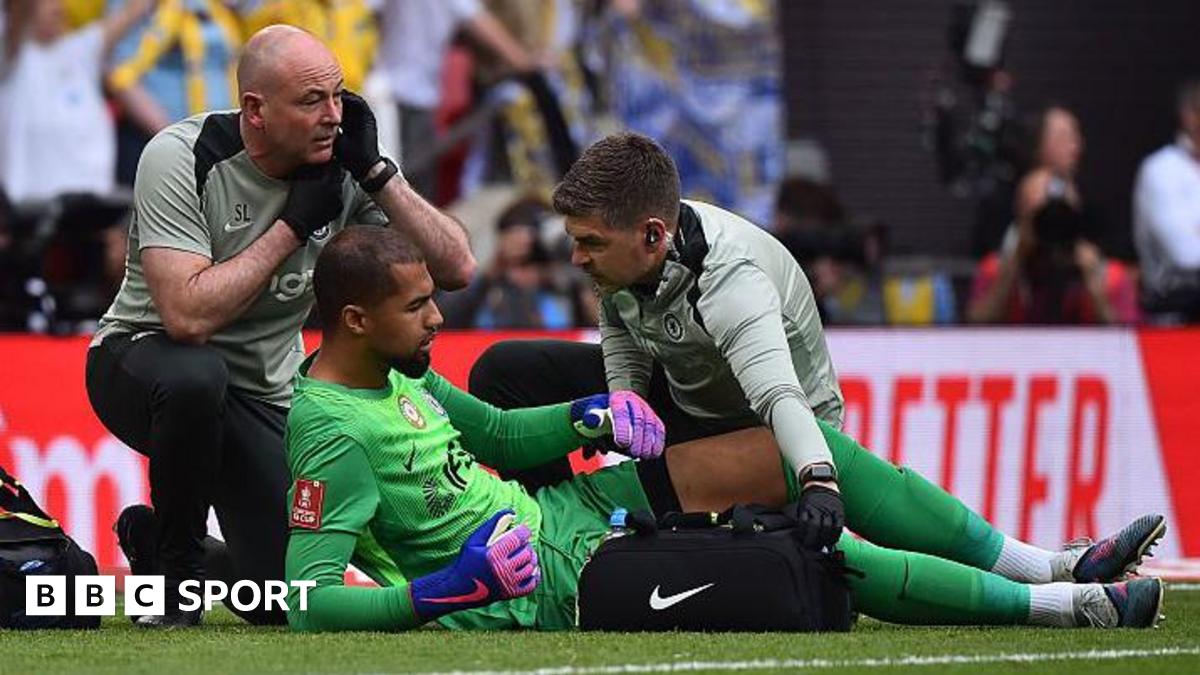
Chelsea goalkeeper Robert Sanchez sat down on the Wembley turf during Sunday's FA Cup semi-final against Leeds United, prompting a stoppage that reignited debate over football's growing 'tactical timeout' problem. Referee Jarred Gillett allowed medical staff onto the pitch, while all of Chelsea's outfield players moved to the technical area for instructions — a scene increasingly familiar across the sport. Leeds fans responded with loud boos, and captain Ethan Ampadu attempted to disrupt the team talk, highlighting growing frustration.
The goalkeeper 'tactical timeout' loophole
Until recently, outfield players were the primary users of simulated injuries to halt play and allow coaching interventions. After leagues introduced a 30-second rule — requiring treated players to leave the pitch briefly — teams adapted by using the goalkeeper. Since a side cannot play without a keeper, the tactic became risk-free: the moment the coach finishes speaking, the goalkeeper often recovers instantly.
This issue is not isolated to one club or match. It has plagued Leeds throughout the season, including a November incident involving Manchester City goalkeeper Gianluigi Donnarumma at the Etihad Stadium. Manager Daniel Farke accused Donnarumma of bending the rules to disrupt Leeds’ momentum. The problem is widespread, affecting men’s and women’s football alike, with increasing frequency in the Women's Super League.
IFAB's response: trials for 2026-27 season
The International Football Association Board (Ifab) has acknowledged the issue but has not implemented immediate law changes. Instead, it will trial four potential solutions during the 2026-27 season, with results reviewed in March 2027 ahead of possible global adoption. The WSL has volunteered to participate.
Trial one: One-minute substitution for treated goalkeeper
Building on the new one-minute off-field rule for injured players, this trial would require a team to send an outfield player off for 60 seconds if the goalkeeper receives treatment. The player could be the captain or one chosen by the manager. While consistent with existing rules, some argue it may not be a strong enough deterrent.
Trial two: Two-minute substitution
This option doubles the time an outfield player must spend off the pitch to two minutes. Proponents believe a longer sanction would discourage tactical misuse. Critics warn it might discourage goalkeepers from seeking legitimate medical help due to fear of disadvantaging their team.
Trial three: No access to technical area
Adopted by the National Women's Soccer League (NWSL) in the US and Canada, this rule requires players to remain where they were when play stopped or gather at their half of the centre-circle. Approaching the technical area risks disciplinary action. However, it does not prevent a goalkeeper from going down tactically — only limits the resulting team huddle.
Trial four: The hybrid model
Combining elements of the first and third trials, this model bans players from the technical area and requires an outfield player to leave the field for one minute. Seen by some technical panel members as the most comprehensive solution, it targets both the stoppage and the tactical team talk.
What’s next?
While Ifab has been criticised for moving slowly, the upcoming trials represent the first coordinated effort to address the issue at a global level. With the problem escalating across leagues and formats, the 2026-27 season could mark the beginning of meaningful change.